
Blog
Field notes from the lab.
What we measured, what broke, and what we would tell a colleague. Filter by what you came for.

Cybersecurity
UTSA's $7.6M Cyber Preparedness Award Adds AI Governance and Deepfake Training: Our Read
On November 24, 2026, UTSA announced $7.6 million in continued FEMA funding for the National Cybersecurity Preparedness Consortium, led by its Center for Infrastructure Assurance and Security, including new courses on AI governance and deepfake threats. Here is what was announced and what local governments should do now.
Read →
Quantum computing
Room-Temperature Quantum at the Edge: Our Read on Rotonium's Prototype
On November 23, 2026, Rotonium unveiled a four-qubit photonic quantum prototype that it says runs at room temperature with no cryogenics, aimed at robots, vehicles and satellites. Here is what was announced, what was not, and what edge and mission programs should do now.
Read →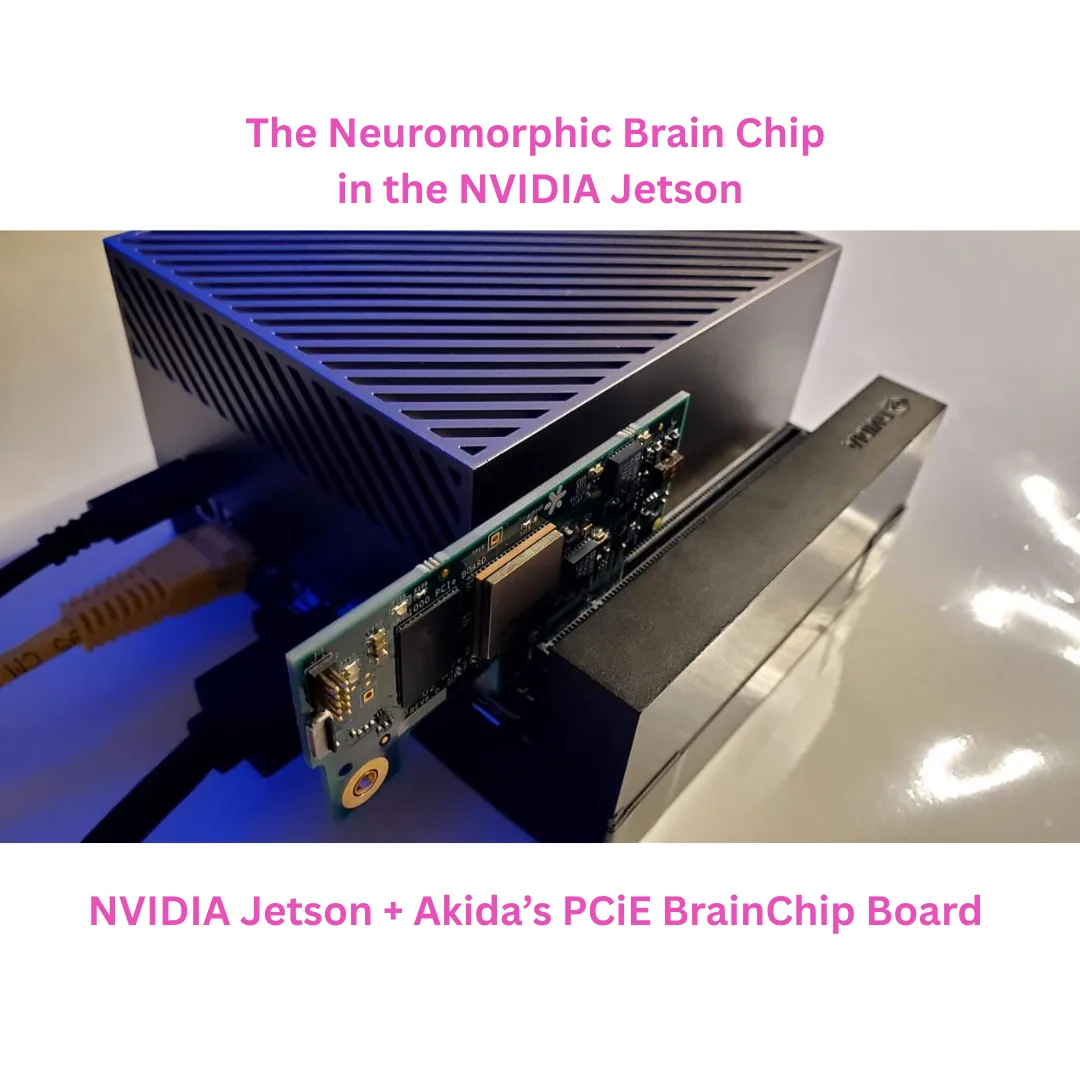
Neuromorphic & physical AI
Eight Akida Chips in One Box: Our Read on BrainChip's Multi-Chip Results
On November 19, 2026, BrainChip published results from an eight-chip Akida system: 7.7 to 113 frames per second on a large image model, near linear scaling on a small one, and about 15.7 million I/Q samples per second on RF. Here is what was reported, what was not, and why the host matters most.
Read →
Cybersecurity
UTSA's New National Security Master's: What It Means for San Antonio AI Teams
On November 19, 2026, UT San Antonio announced a proposed master's degree in national security that blends AI, cybersecurity, data science and policy, expected by fall 2027 pending approvals. Here is what was announced, what was not, and what San Antonio programs and contractors should do now.
Read →Quantum computing
IonQ's Federal Advisory Board: Three Questions Mission Buyers Should Answer First
On November 17, 2026, IonQ introduced a Federal Advisory Board of former NSA, DIA, DARPA, Army Futures Command and industry leaders. Here is what was announced, what was not, and the three questions every mission program should answer before any quantum pilot.
Read →
Neuromorphic & physical AI
DARPA Triage Challenge Finals: What the Results Mean for Physical AI
The DARPA Triage Challenge Finals ended November 13, 2026 at Disaster City in College Station, Texas, with RoboScout winning the Systems competition and Disruptors the Data competition. Here is what DARPA confirmed and our read on what it means for physical AI and mission data teams.
Read →Applied AI
ARTEX: A Defender's Guide for San Antonio
The FBI and major vendors have published public reporting on ARTEX, an agentic penetration testing framework used in real intrusions. This guide is for San Antonio teams and defense contractors. It summarizes what those sources say, lists practical questions to ask, and links to the MagenTrust and CENTARGUS explainers. It does not publish product test results.
Read →Quantum computing
Atom Computing's $100M Commerce Award: What It Means for Mission Quantum Plans
On November 13, 2026, the Department of Commerce finalized a CHIPS R&D award of up to $100 million to Atom Computing for utility-scale, fault-tolerant neutral-atom quantum computers. Here is what was announced, what was not, and what mission programs should do before the hardware arrives.
Read →Neuromorphic & physical AI
BrainChip AKD1500: Add On-Device AI Without Replacing the Host
On November 13, 2026, BrainChip published a briefing on AKD1500, a dedicated neuromorphic co-processor meant to sit beside the host you already ship. Here is what the SPI and PCIe variants actually change, and how that fits the hybrid design we already measure in the lab.
Read →
Applied AI
Custom Small Language Model Development: Pay for Tasks That Work, Not Tokens
Small language models only save money when the task is narrow, the data is clean and someone owns the model after launch. Here is how to scope a custom SLM that lowers your cost per successful task, and where it should run.
Read →
Data & research
On-Prem and Air-Gapped Security Operations for Hospitals and Critical Networks
This week a cyberattack diverted ambulances from a New Mexico hospital system. For critical networks, the real cost of an attack is downtime. Here is how CENTARGUS keeps security operations inside your boundary and keeps people in charge of critical response.
Read →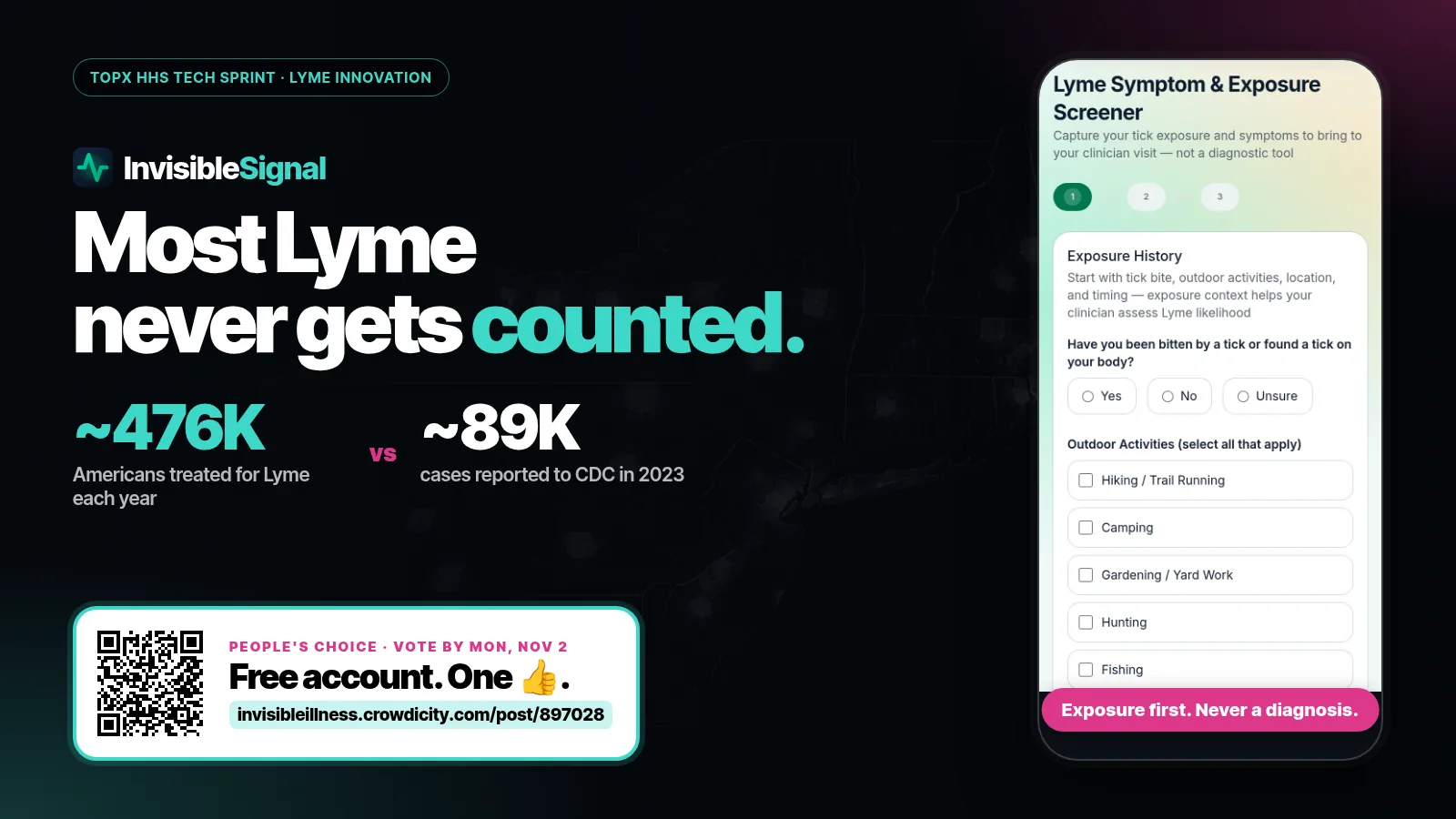
Data & research
Why InvisibleSignal Matters: Closing Lyme's Visibility Gap, and How to Vote
About 476,000 Americans are treated for Lyme each year, but only about 89,000 cases were reported in 2023. Here is why that visibility gap matters, how InvisibleSignal helps from tick bite to clinic without pretending to diagnose, and how to vote for it in People's Choice.
Read →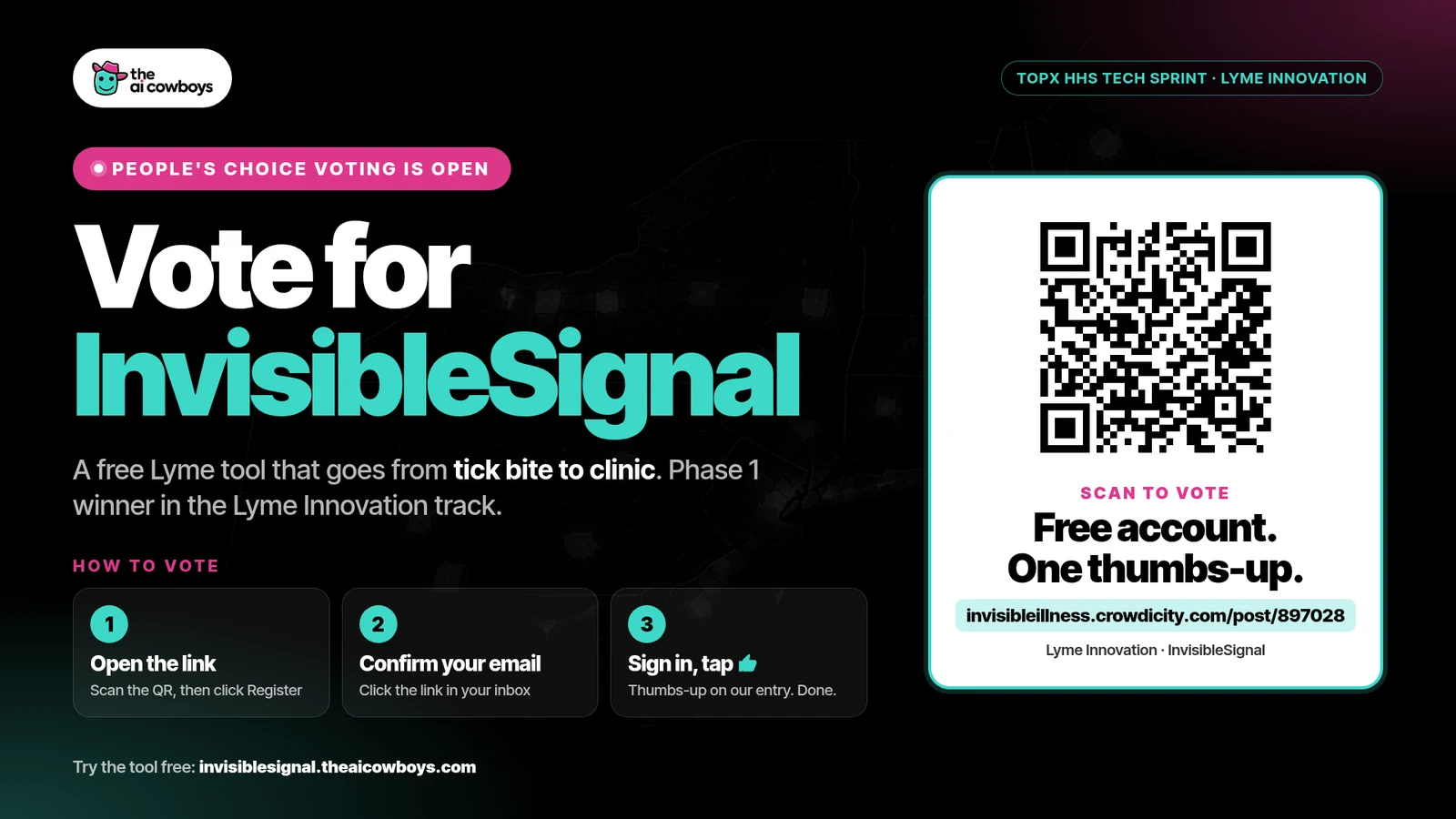
Data & research
Vote for InvisibleSignal: People's Choice Voting Is Open in the TOPx HHS Tech Sprint
People's Choice voting is open in the TOPx HHS Tech Sprint for AI and Invisible Illness, and InvisibleSignal, our Lyme Innovation entry, is on the ballot. Here is why we built it, what it does, and how to vote with a free account and one thumbs-up.
Read →
Applied AI
How to Choose an AI Company in San Antonio: Questions to Ask
San Antonio has AI consultants, software shops, data firms and research labs, and they are not interchangeable. This buyer's checklist explains the differences, the ten questions worth asking any AI company, how good engagements are structured, and the warning signs.
Read →
Applied AI
CMMC and AI Tools: What Defense Contractors Need to Know
AI assistants, coding tools and agents are now in every defense contractor's workflow, and every one of them can touch controlled unclassified information. This guide maps where AI meets CMMC, what deployment options keep you inside your boundary, and what to ask an AI vendor before your assessment.
Read →
Applied AI
Air-Gapped LLM Deployment: An On-Prem Guide for Regulated Teams
Running a language model where no data can leave is mostly an engineering problem around the model, not in it. This guide covers the difference between on-prem and air-gapped, a reference architecture, how to size hardware, how updates cross the gap, and how to evaluate inside the perimeter.
Read →Neuromorphic & physical AI
BrainChip Akida vs NVIDIA Jetson: Power, Fit and Where Each Belongs
Akida and Jetson are usually framed as rivals. They are better understood as two halves of an edge AI system: an event-driven front end that watches cheaply, and a GPU that wakes when there is real work. Here is how they differ and how to split a workload between them.
Read →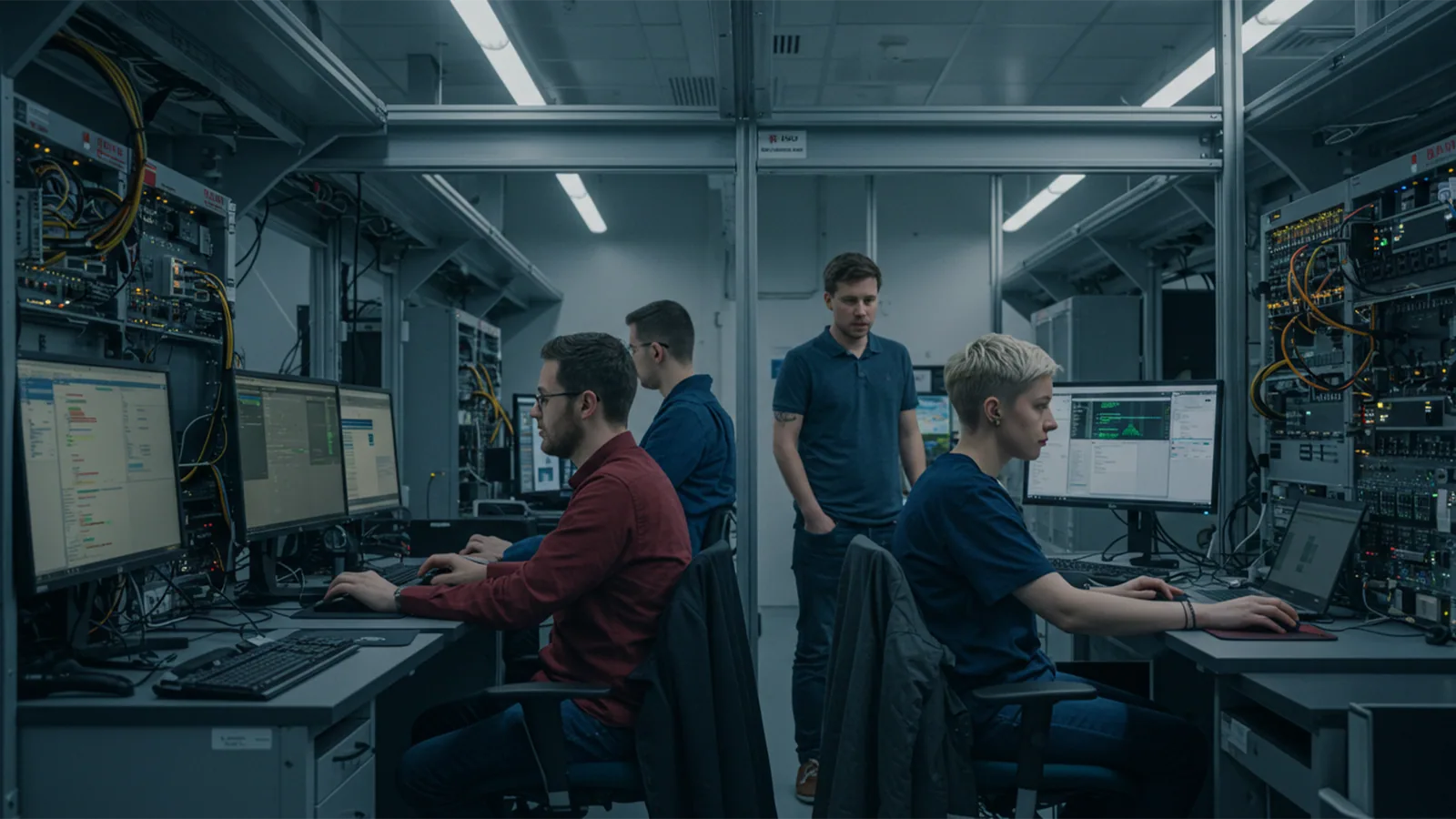
Applied AI
How to Independently Validate a Vendor's AI Noise-Robustness Claims
"Robust to noise" is one of the most common claims on an AI datasheet and one of the least tested. Here is a vendor-neutral test plan any buyer can use: define the claim, freeze the protocol, sweep realistic noise on held-out data, and report degradation as a curve.
Read →
Data & research
How to Buy Human-Labeled Datasets for AI Models
Human-labeled data is still what most production models learn from and are judged against. This guide covers when you need it, off-the-shelf versus custom collection, the questions that separate an auditable dataset from a pile of labels, and how to scope a purchase.
Read →
Applied AI
Everyone in San Antonio Has an Opinion About the Budget. Now Everyone Has the Numbers.
San Antonio is disputing a $4.4 billion budget, a $157.7 million gap, and the first property tax rate increase in 34 years. The Ledger, built by The AI Cowboys, turns the city's own public documents into an interactive machine so residents can check the math and form their own opinion before the September 17 vote.
Read →
Applied AI
Third-Party Validation: Proving a Product Does What It Claims
Vendors measure their own products, and buyers cannot tell a real result from a well-lit one. Here is what independent third-party validation is, what it measures for AI hardware and software, and the structural conditions that make a validator credible.
Read →
Neuromorphic & physical AI
Embodied AI: Why Having a Body Changes the Problem
Physical AI describes what a system does. Embodied AI describes where its intelligence comes from. That distinction changes how you instrument, train and verify a machine, and this is what it changes.
Read →Neuromorphic & physical AI
Physical AI: What It Actually Is, and What It Costs to Deploy
Physical AI is the part of AI that has to be right in front of something real. Here is a precise definition, three deployed case studies, and the watts-per-platform constraint that decides what makes it out of the lab.
Read →
Data & research
Synthetic Data for Federal AI: Training Models When the Real Data Is Sensitive
The best training data for federal AI is often the data you're not allowed to use. Synthetic data resolves that paradox, provided it's generated with rigor and validated honestly. Here's how mature programs approach it.
Read →Cybersecurity
AI-Native Cybersecurity: What an Autonomous SOC Actually Does
Bolting AI onto a legacy SOC gets you faster alerts. Building the SOC around AI gets you something different: investigation, response, forensics, and compliance that run themselves, with humans setting intent instead of clearing queues.
Read →
Neuromorphic & physical AI
The Importance of Neuromorphic Computing: Why Brain-Inspired Chips Are the Next Strategic Advantage
GPUs made modern AI possible, but they made it power-hungry. Neuromorphic chips process information the way brains do: event-driven, massively parallel, and thousands of times more efficient. Here's why that matters for defense, edge AI, and cybersecurity.
Read →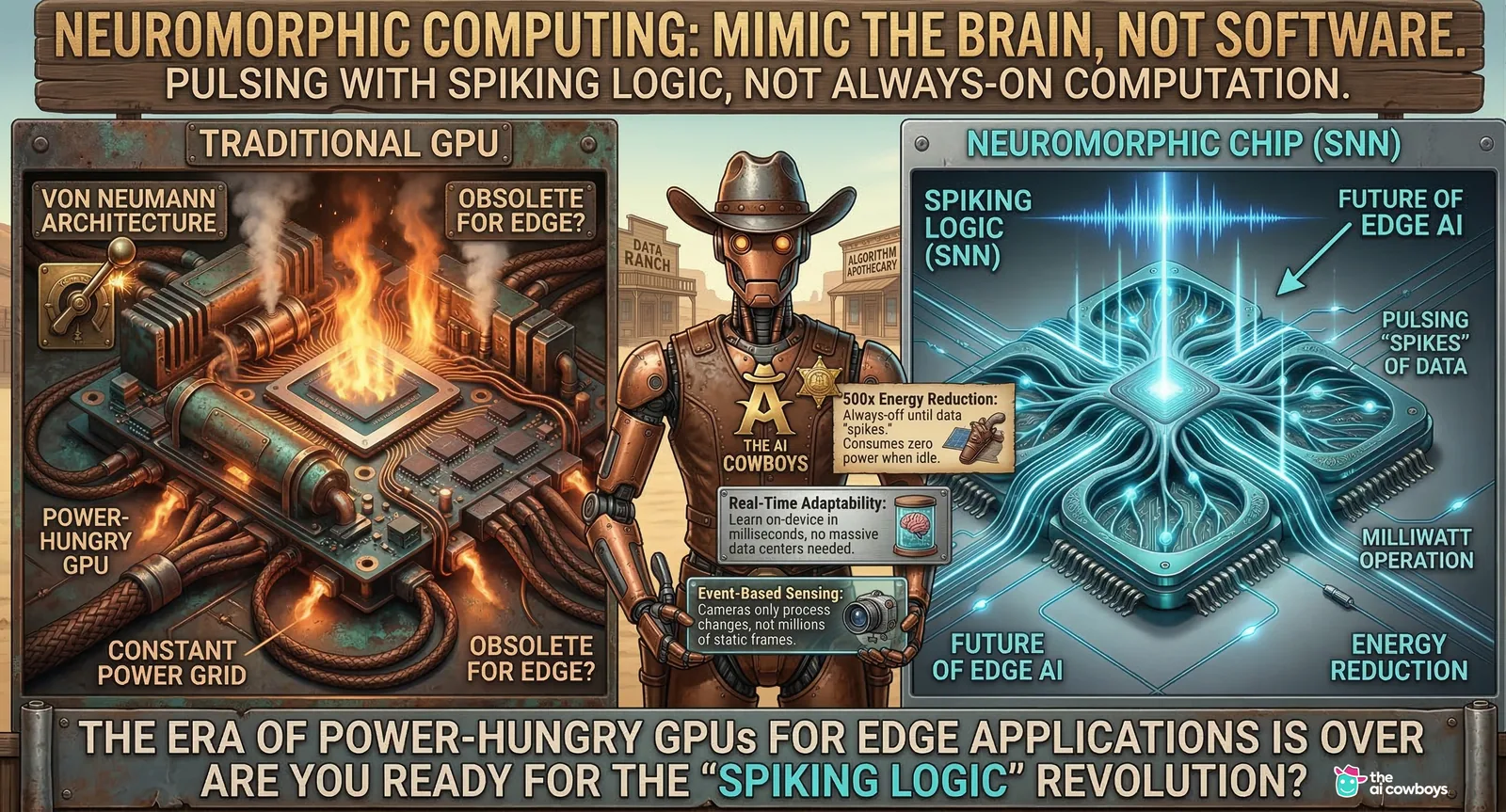
Neuromorphic & physical AI
Neuromorphic Edge AI: Why the Future of Intelligence Will Mimic the Brain, Not the Computer
Neuromorphic Edge AI is reshaping how real-time intelligence gets built. Learn how spiking neural networks, event-driven systems, and low-power edge architectures are changing cybersecurity, RTTP, and next-generation AI deployment.
Read →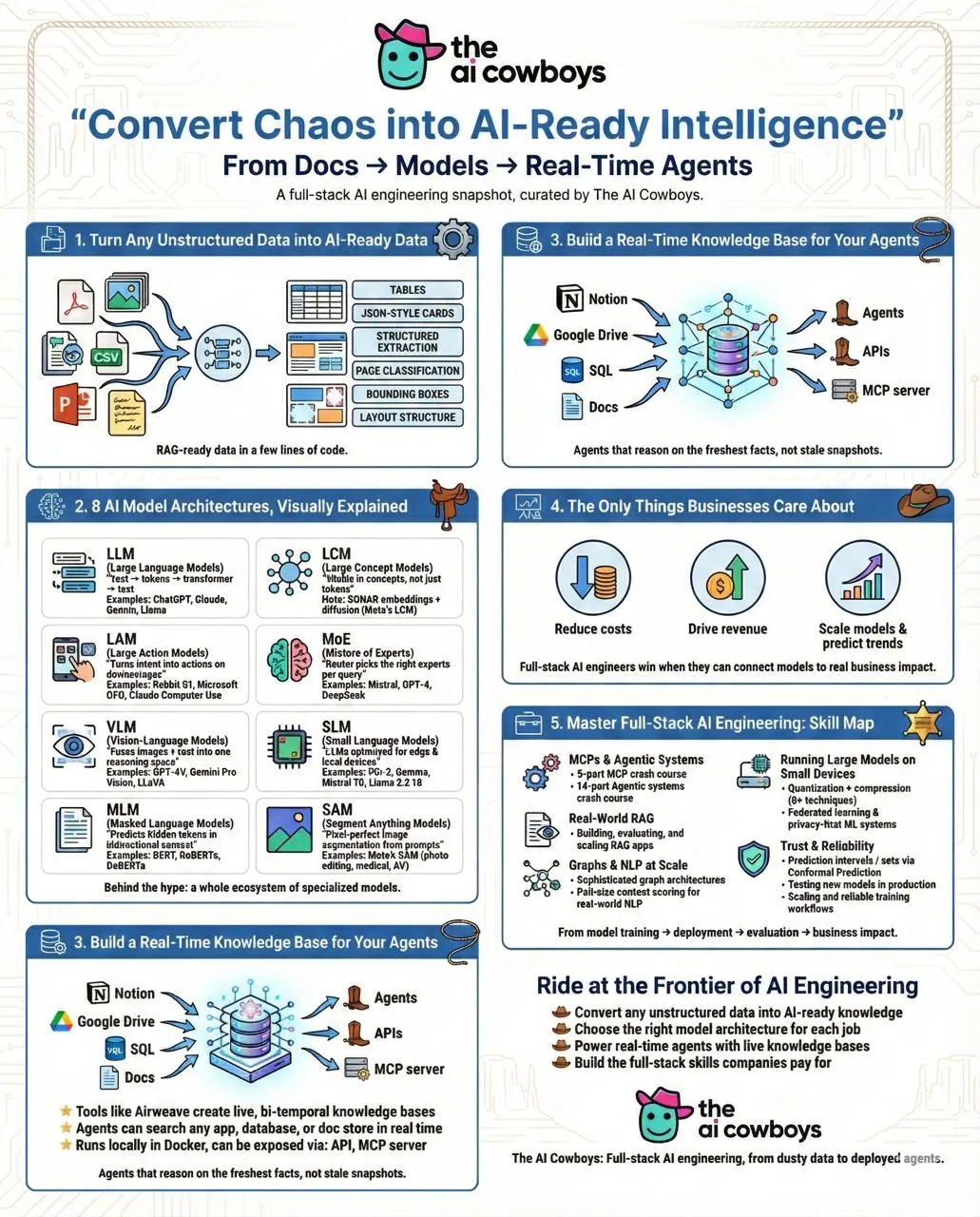
Applied AI
How large language models are changing AI engineering in 2026
Large Language Models (LLMs) are reshaping how organizations convert raw data into real-time intelligence. This article breaks down what LLMs are, how they work, and why they’re the backbone of modern AI engineering, from document parsing to autonomous agents. Learn how businesses are using LLM-powered systems to reduce costs, unlock revenue, and scale smarter.
Read →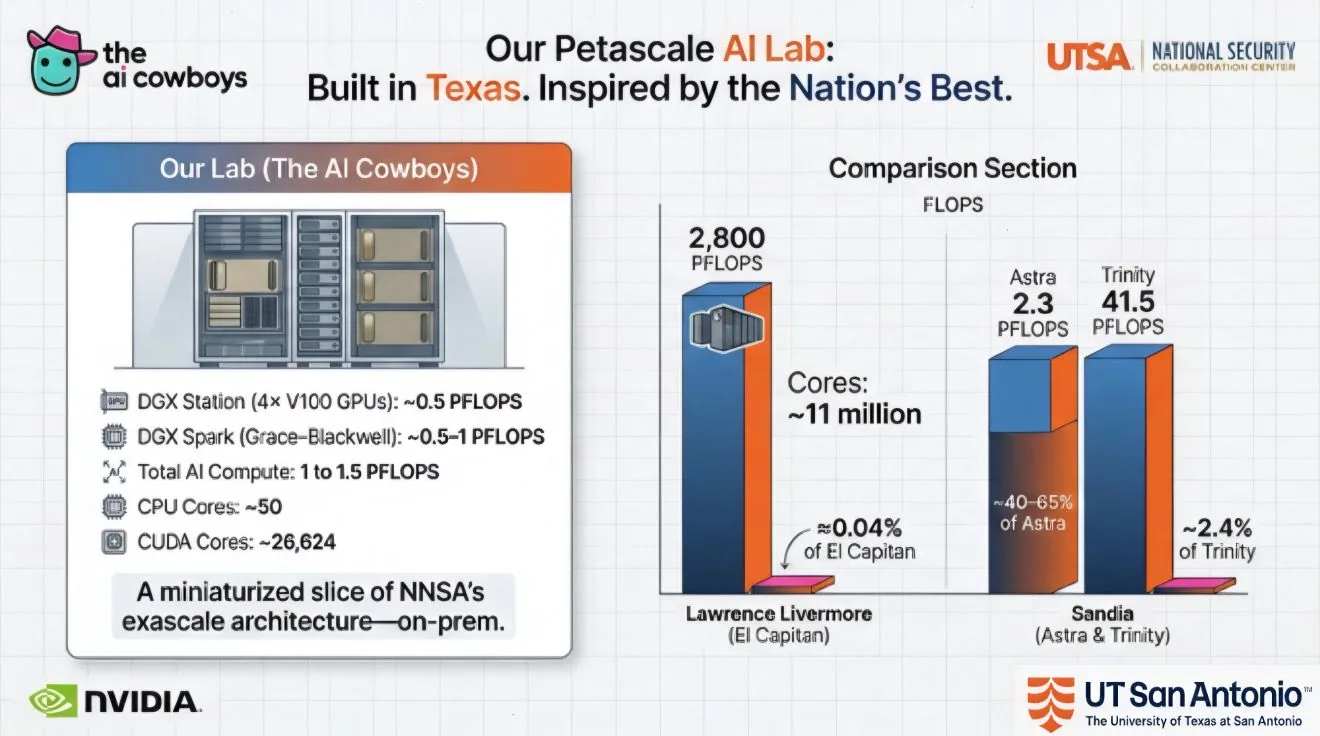
Applied AI
Inside the Petascale AI Lab at UT San Antonio
San Antonio now has its own petascale AI Lab. The AI Cowboys built this at The University of Texas at San Antonio. With 1–1.5 PFLOPS of compute, 26,624 CUDA cores, and exascale-class architecture, this lab is the most advanced publicly documented AI compute center in the city. Here’s why it matters for research, national security, and enterprise AI innovation.
Read →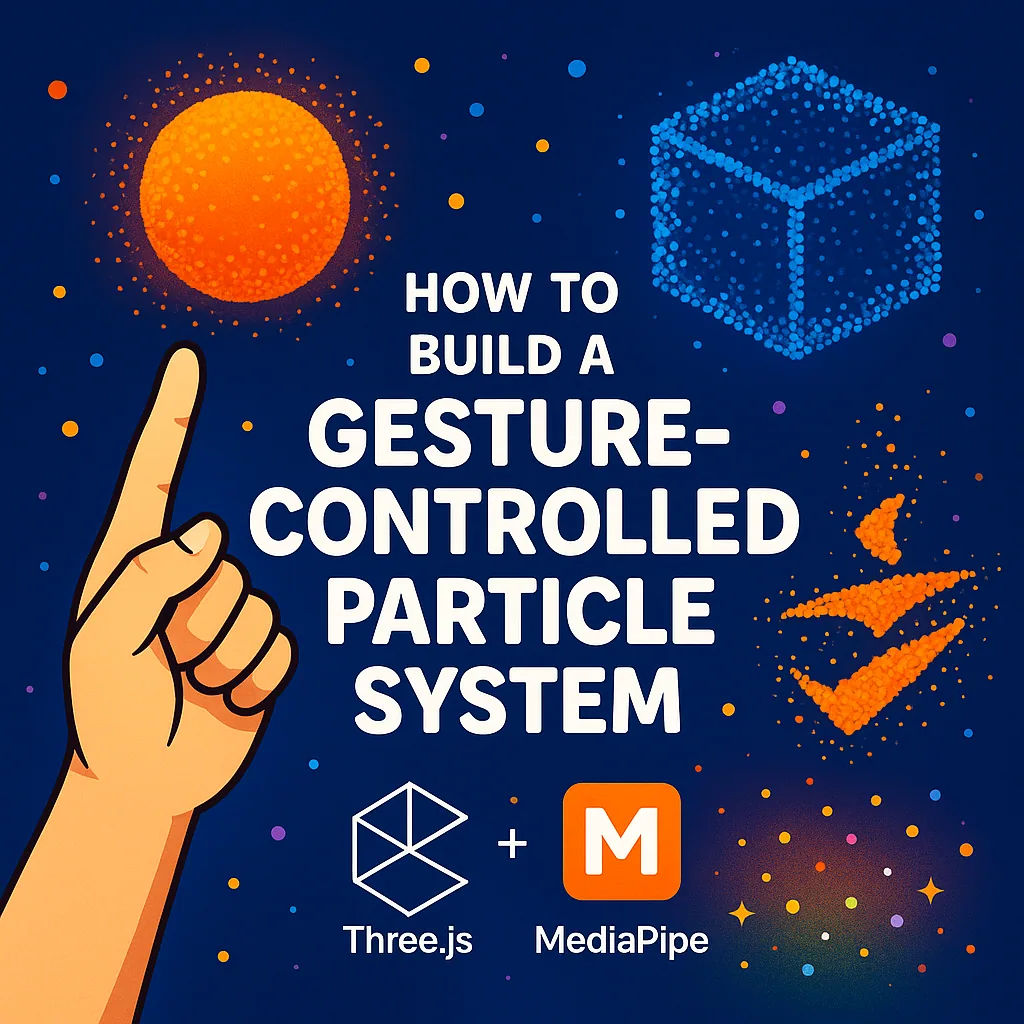
Applied AI
How to Build a Gesture-Controlled Particle System Using Google AI Studio, Three.js, and MediaPipe
Learn how to build a browser-based, gesture-controlled 3D particle system using Google AI Studio, Three.js, and MediaPipe Hands. This tutorial includes full source code, setup steps, and links to all tools, showing you how to turn real-time hand gestures into animated shapes like spheres, cubes, the UTSA logo, and The AI Cowboys logo.
Read →Neuromorphic & physical AI
Neuromorphic brain chip on NVIDIA Jetson: edge AI from San Antonio
The AI Cowboys are rewiring AI with neuromorphic computing inside NVIDIA Jetson. Powered by BrainChip Akida, our hybrid system reduces power consumption by 90% and operates off-grid, bringing brain-like intelligence to the edge. See it at our UT San Antonio AI Lab. We’re always cookin’ something.
Read →
Applied AI
AI-Driven Customer Support: Smarter Service, Greater Satisfaction
Discover how The AI Cowboys transform customer support with AI-driven virtual agents, adaptive learning, and human-in-the-loop intelligence. Learn how businesses, universities, and government agencies are cutting costs, improving satisfaction, and scaling their support operations with intelligent, always-on service.
Read →
Applied AI
Custom Software Development: Building AI-Powered Solutions for the Future
The AI Cowboys deliver tailored software development services in San Antonio, Texas, specializing in AI, machine learning, and automation. From enterprise platforms to government applications, we design secure, scalable, and future-ready systems that help organizations thrive.
Read →
Applied AI
Enterprise AI Solutions: Transforming Business at Scale
AI Cowboys helps enterprises integrate AI into everyday operations, from automating workflows to deploying secure, scalable AI infrastructure. Based in San Antonio, we specialize in HIPAA-compliant, enterprise-ready AI that drives efficiency, reduces costs, and fuels innovation.
Read →Quantum computing
Quantum Computing Integration: Powering the Next Wave of AI Innovation
The AI Cowboys help organizations integrate quantum computing with AI to solve problems that classical systems can’t handle. Based in San Antonio, we deliver hybrid AI/quantum solutions for government, healthcare, research, and enterprise clients.
Read →
Data & research
Healthcare & Biomedical AI Solutions: Transforming Medicine with The AI Cowboys
The AI Cowboys provide healthcare and biomedical AI solutions that accelerate research, enhance diagnostics, and secure patient data at scale. By combining HIPAA-compliant infrastructure with Topology-on-Demand (ToD) computing, we empower researchers, hospitals, and enterprises to innovate without limits.
Read →
Data & research
AI-Enhanced Research Tools: Empowering Innovation with The AI Cowboys
The AI Cowboys builds advanced AI-powered research tools in San Antonio, Texas. Our solutions accelerate discovery, automate analysis, and make complex data accessible across healthcare, government, and academia.
Read →
Data & research
Synthetic Data Services: Scalable, Secure, and Smart AI Training with The AI Cowboys
The AI Cowboys deliver synthetic data services that accelerate AI training, safeguard privacy, and unlock new possibilities for innovation. From healthcare to government applications, our synthetic datasets provide safe, scalable, and bias-reducing alternatives to sensitive real-world data.
Read →Data & research
Real-World Data Services: Turning Human-Validated Data into AI Power
The AI Cowboys deliver Real-World Data (RWD) services that transform raw information into human-validated, actionable datasets. By providing clean, regulatory-compliant data, we help organizations improve AI accuracy, reduce hallucinations, and accelerate deployment in critical sectors.
Read →Training & workforce
AI Workshops & Training: Building Skills for the Future of Work
The AI Cowboys deliver hands-on AI workshops and training programs that empower professionals, students, and organizations to leverage AI tools, machine learning, and EduTech innovations. From prompt engineering to enterprise deployment, our training helps Texas and beyond prepare for the future of work.
Read →
Applied AI
Large Language Model Solutions: Unlocking AI’s Full Potential for Business and Research
The AI Cowboys deliver customized Large Language Model (LLM) solutions from San Antonio, Texas. From fine-tuning AI assistants to powering enterprise search and biomedical research, our LLM services make advanced AI practical, secure, and scalable.
Read →
Applied AI
Top AI News You Might Have Missed in March
AI is evolving at record speed, and this week brought game-changing breakthroughs. From Grok 3’s wild voice modes to Microsoft’s efficient Phi-4 models, we break down the top 7 AI updates you need to know about. Discover how companies like OpenAI, Amazon, and Anthropic are pushing AI closer to human-like intelligence and what it means for the future of automation, creativity, and communication.
Read →