
· By Roger Wong Won
Eight Akida Chips in One Box: Our Read on BrainChip's Multi-Chip Results
On November 19, 2026, BrainChip published results from an eight-chip Akida system: 7.7 to 113 frames per second on a large image model, near linear scaling on a small one, and about 15.7 million I/Q samples per second on RF. Here is what was reported, what was not, and why the host matters most.
On November 19, 2026, BrainChip published results from putting eight Akida 1.0 (AKD1500) M.2 cards in a single Intel Core i7 mini-PC and spreading work across them. The headline numbers are strong: a large image model went from 7.7 to 113 frames per second, a small one scaled almost perfectly, and a wide-band RF classifier reached about 15.7 million I/Q samples per second. The line we care about most is further down: the host, not the chips, is the real design choice.
These are BrainChip's measurements on BrainChip's test system. We have not reproduced them. Here is what was reported, what it does not tell you yet, and how it fits the edge, neuromorphic and mission data work we do.
What BrainChip reported
According to the post, written by BrainChip machine learning engineer Amir Naderi, AkidaNet 1.0 at 224 by 224 pixels needs about 3.7 chips' worth of resources. On one chip it has to keep reloading layers and reached 7.7 frames per second. Split into stages across eight chips, with extra copies of the slowest stages, it reached 113 frames per second, a 14.7x gain, and latency fell from 131 ms to 84 ms. BrainChip explains the better than linear result simply: each chip loads its stage once and stays busy instead of swapping layers in and out. It also says its planning tool chose the split automatically and predicted speed within about 2% of what was measured.
The smaller AkidaNet 0.5 went from 41 frames per second on one chip to 326 on eight, about 99% scaling efficiency. BrainChip also reports that cutting the network at all 14 possible split points gave identical results every time, and that four different models on four chips delivered about 1,200 inferences per second in total.
For RF, each of the eight cards ran the same 4-bit automatic modulation classification network independently on its own stream of 1,024-sample frames, behind a PCIe switch, with no data passing between chips. At batch 64, BrainChip reports about 1,920 frames per second per chip and 15,356 frames per second across all eight, with every chip's predictions matching a CPU reference frame for frame.
The host is the story
BrainChip is candid that the hard lessons came from the host. The Akida runtime lets only one process open the chips and runs them one at a time within that process, so reaching the full rate took one container per chip. The runtime also keeps a CPU core busy for each chip, and the host's processor platform power rose from 12 W idle to about 60 W. BrainChip puts that at about 3.9 mJ per frame at the host, against an estimated 0.14 mJ on the chips themselves, and recommends microcontroller or FPGA class hosts rather than a PC for low-power multi-chip systems.
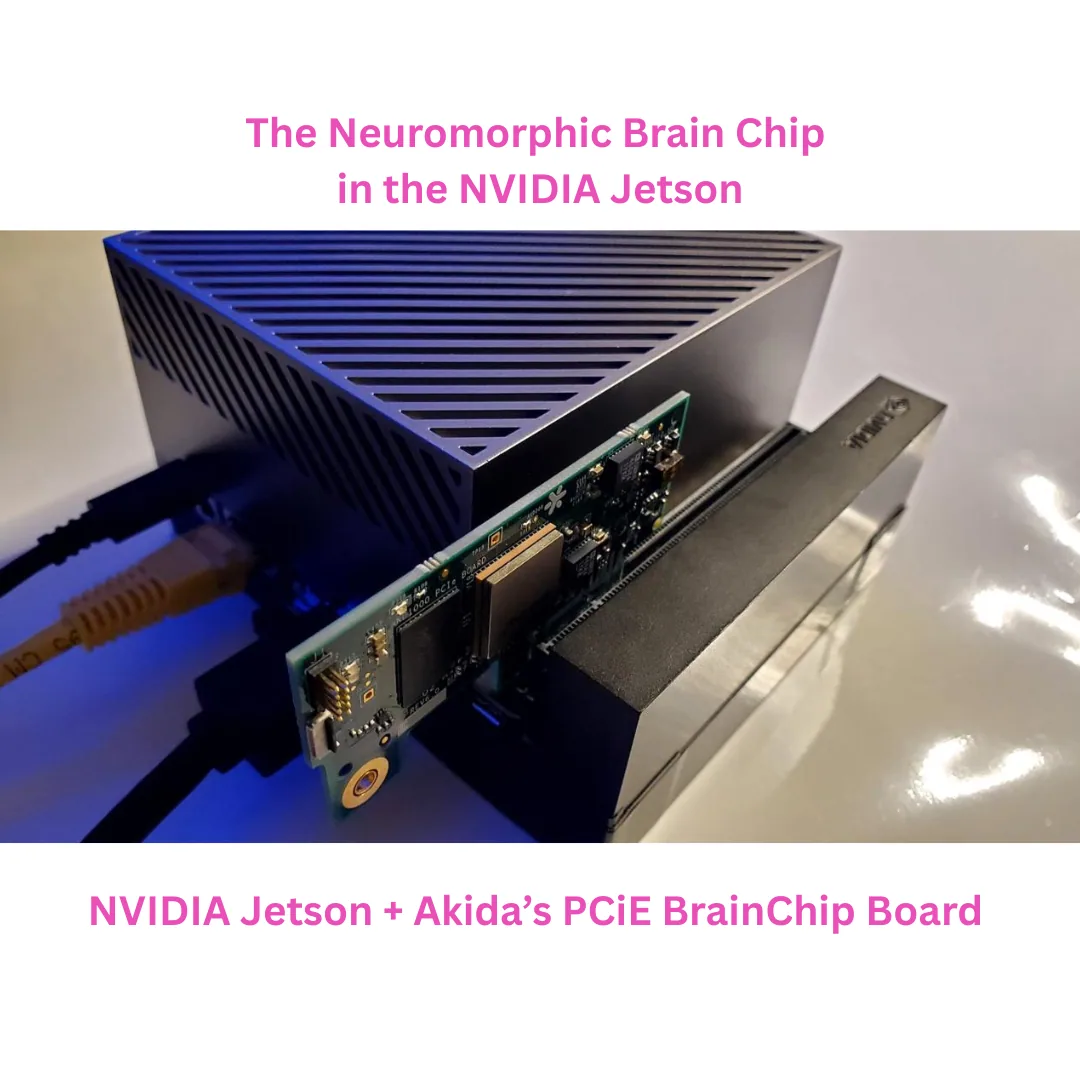
That matches how we think about every edge design. The accelerator's number is never the system's number. Our published lab result is a different measurement on a different setup: in San Antonio, a hybrid NVIDIA Jetson plus BrainChip Akida deployment held the same accuracy at 9 W that the Jetson alone needed 120 W to reach. That was one Akida board alongside a Jetson, measured against a Jetson only baseline. We did not measure an eight-chip system, AKD1500 M.2 cards, the RF workload or BrainChip's mini-PC host, and nothing in this post should be read as combining the two results. What both have in common is the method: hold the workload and accuracy fixed, then count the watts of everything that has to be powered, host included.
What it could mean for mission systems
Our interpretation, and it is only that. Three parts of this post matter for defense and mission data teams.
Wide-band RF that scales by adding cards. Because each chip classifies its own slice of the band with no traffic between chips, coverage grows with card count. For spectrum monitoring and RF sensing at the edge, that is a cleaner scaling story than one bigger accelerator, provided the host can keep up with the data.
Splitting without changing the answer. Identical outputs across every split point, and RF predictions that matched a CPU reference frame for frame, are the kind of evidence an assurance or test team asks for. It makes a multi-chip pipeline easier to validate against a known reference, which is the heart of our cybersecurity and AI trust work.
Bigger models without leaving the edge. For a model too large for one low-power chip, partitioning across several is an alternative to sending data to a larger processor or off the platform. For air-gapped and denied-link systems, keeping inference local is often the requirement, not a preference.
What the post does not settle: power and performance on a microcontroller or FPGA host, which BrainChip recommends but did not report here, accuracy on a fielded detection task, and the high-resolution tiling result, which BrainChip itself says shows a direction rather than a benchmark. BrainChip also notes its cross-generation CenterNet detector runs on Akida 1.0 hardware but is not yet accurate enough to deploy.
How we would qualify it
If we were evaluating a multi-chip Akida design for a customer, we would start from the host the platform can actually carry, fix the model, the input rate and the accuracy target, and measure throughput, latency and watts at the wall for the whole box, then compare it with a single-chip design and a GPU only baseline. That is the same discipline behind our Akida versus Jetson comparison and our read on AKD1500 as a co-processor. Until those numbers exist for a named workload, we will not invent them.
If you are scoping an edge, RF or always-on sensing system and want help choosing between one chip, several chips or a hybrid design, request a briefing or email contact_us@theaicowboys.com. More of this work lives on our neuromorphic computing, edge AI and government and defense pages.
Common questions
What did BrainChip's eight-chip Akida test show?
BrainChip reports that eight Akida 1.0 (AKD1500) M.2 cards in one Intel Core i7 mini-PC raised AkidaNet 1.0 throughput from 7.7 to 113 frames per second (14.7x), scaled AkidaNet 0.5 from 41 to 326 frames per second, and ran an RF modulation classifier at 15,356 frames per second across all eight chips. These are BrainChip's numbers; we have not reproduced them.
Is this the same as The AI Cowboys' 9 W versus 120 W result?
No. Our published result is a hybrid NVIDIA Jetson plus one BrainChip Akida board in our San Antonio lab, which held the same accuracy at 9 W that the Jetson alone needed 120 W to reach. We did not measure an eight-chip system, AKD1500 M.2 cards or the RF workload, and the two results should not be combined.
Why does the host matter so much in a multi-chip system?
BrainChip reports that the runtime kept a CPU core busy per chip, so host power rose from 12 W idle to about 60 W, roughly 3.9 mJ per frame at the host against an estimated 0.14 mJ on the chips. It recommends microcontroller or FPGA class hosts for low-power multi-chip designs.