
· By Roger Wong Won
Why InvisibleSignal Matters: Closing Lyme's Visibility Gap, and How to Vote
About 476,000 Americans are treated for Lyme each year, but only about 89,000 cases were reported in 2023. Here is why that visibility gap matters, how InvisibleSignal helps from tick bite to clinic without pretending to diagnose, and how to vote for it in People's Choice.
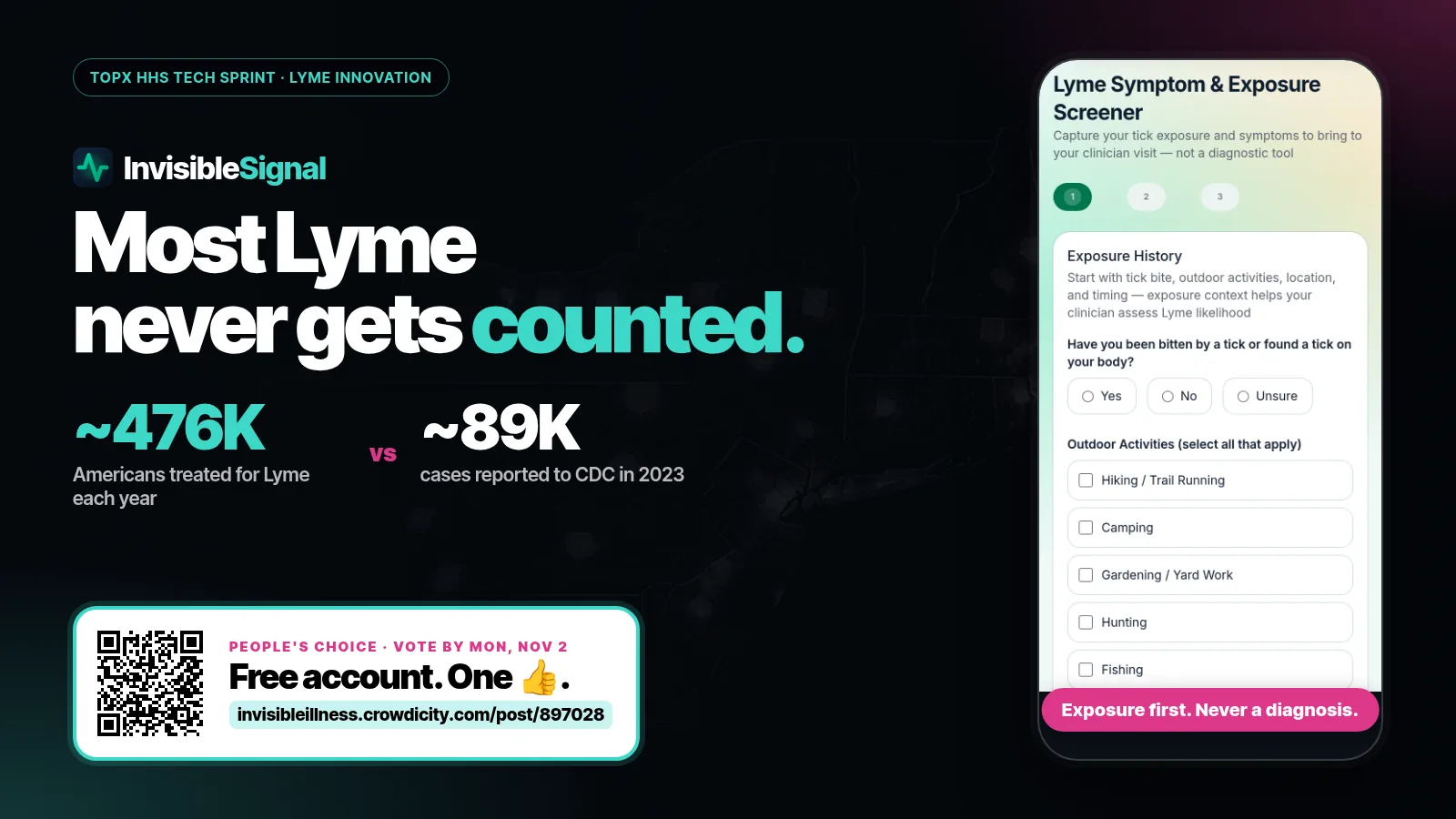
Most Lyme disease never shows up in the numbers. CDC estimates that about 476,000 Americans are diagnosed and treated for Lyme each year, yet only about 89,000 cases were reported through national surveillance in 2023. That gap is the reason we built InvisibleSignal, and the reason we are asking for your vote in People's Choice for the TOPx HHS Tech Sprint. Voting takes a free account and one thumbs-up: vote for InvisibleSignal here.
The visibility gap in Lyme disease
A disease that is hard to count is hard to fund, hard to plan for and easy to dismiss. Most of the Lyme cases treated each year never reach the national surveillance count. An estimated 31 million Americans are bitten by ticks every year, and most of those bites are never written down anywhere.
The gap does not stay in the data. It follows people into the exam room. Two-tier testing has under 50% sensitivity in early disease. Up to 30% of patients never develop the classic bull's-eye rash. In patient surveys, 51% report that it took more than three years to be diagnosed. When the rash is missing and the test is negative, the tick bite from three weeks ago is often the one fact nobody asks about.
Where the patient journey breaks
Picture the usual path. Someone pulls a tick off after a hike, gardening or a hunting trip. They are not sure what kind it was or how long it was attached. Weeks later come fatigue, aches or a fever. By the time they see a clinician, the bite is a vague memory, the photo is buried in a camera roll and the appointment lasts ten minutes. The story starts from zero.
InvisibleSignal is built around that journey, from "I found a tick" to "my clinician has what they need." It is live and free at invisiblesignal.theaicowboys.com, and the public tools need no account. Our CTO, Jacqueline Loyland, led the build.
- At the trailhead: Field Mode works offline. Log a bite with a GPS pin and a photo, with CDC risk data for all 3,231 U.S. counties stored on the device.
- At home: an exposure-first screener asks about tick exposure, season and geography before symptoms.
- At the clinic: your confirmed record exports as an HL7 FHIR R4 document, coded with LOINC, SNOMED and ICD-10, that a clinician's EHR can ingest.
Honest AI that does not diagnose
Health tools that overpromise do real harm, so InvisibleSignal is deliberately modest about what it knows.
- Gaps are labeled as gaps. The county map is built from 152,018 reported cases, reconciled exactly to published state totals. Where CDC could not code a county, the map says so instead of showing a zero. Absence of measurement is never presented as absence of risk.
- Overlap is not a probability. The screener reports symptom overlap as overlap, never as a probability of disease, and it routes red-flag symptoms to emergency care before any model runs.
- Cite or refuse. Answers come from a corpus of 33 findings from 7 published sources. The AI must cite a known source or decline to answer.
- Limits in writing. The risk index uses four published weights and no learned parameters, and it was validated out-of-sample. Every risk brief includes a section titled "What this brief does not establish."
It does not diagnose, and it never pretends to. It helps a person walk into a short appointment with an organized, cited history.
What a People's Choice win would mean
InvisibleSignal was a Phase 1 winner in the Lyme Innovation track of the TOPx HHS Tech Sprint for AI and Invisible Illness, and in Phase 2 we shipped it as a working product, not a prototype. Under the official rules, public voting, leaderboard activity and participant engagement may inform the Federal Judging Panel's decisions, including the People's Choice Awards.
A People's Choice win would be a public signal that people want Lyme tools that are free, honest about uncertainty and useful from bite to clinic. It would also put the visibility gap in front of the people who decide what gets built next.
How to vote in three steps
- Register for free. Open invisibleillness.crowdicity.com/post/897028 and click Register at the top right. Choose a display name, email and password.
- Verify your email. Crowdicity sends a verification link. Click it, and check spam or promotions if it has not arrived in a few minutes.
- Sign in and tap the thumbs-up on the InvisibleSignal entry. There is no thumbs-down.
Anyone can vote, and you do not have to be part of the sprint. Please use one account per person. Real votes from real people are the point.
When to vote
Voting opened October 23, and no official close date has been published. We are asking everyone to vote by Monday, November 2. Phase 2 winners are expected to be announced November 3 at the Edge of Medicine event.
If you have ever pulled a tick off a child, a dog or yourself, this one is for you. Vote, then send the link to one person who would care.
Vote for InvisibleSignal: invisibleillness.crowdicity.com/post/897028
Common questions
Is voting free, and who can vote?
Yes, it is free. Anyone can vote, and you do not need to be part of the sprint. You need a free Crowdicity account with a verified email, and each person should use one account.
How do I vote for InvisibleSignal?
Open invisibleillness.crowdicity.com/post/897028, click Register and create a free account, click the verification link in your email, then sign in and tap the thumbs-up on the InvisibleSignal entry.
When does voting close?
No official close date has been published. Voting opened October 23. We are asking everyone to vote by Monday, November 2, because Phase 2 winners are expected to be announced November 3.
Does InvisibleSignal diagnose Lyme disease?
No. It is exposure-first and reports symptom overlap as overlap, never as a probability of disease. It routes red-flag symptoms to emergency care and helps you bring an organized, cited record to your clinician.