
· By Roger Wong Won
BrainChip Akida vs NVIDIA Jetson: Power, Fit and Where Each Belongs
Akida and Jetson are usually framed as rivals. They are better understood as two halves of an edge AI system: an event-driven front end that watches cheaply, and a GPU that wakes when there is real work. Here is how they differ and how to split a workload between them.
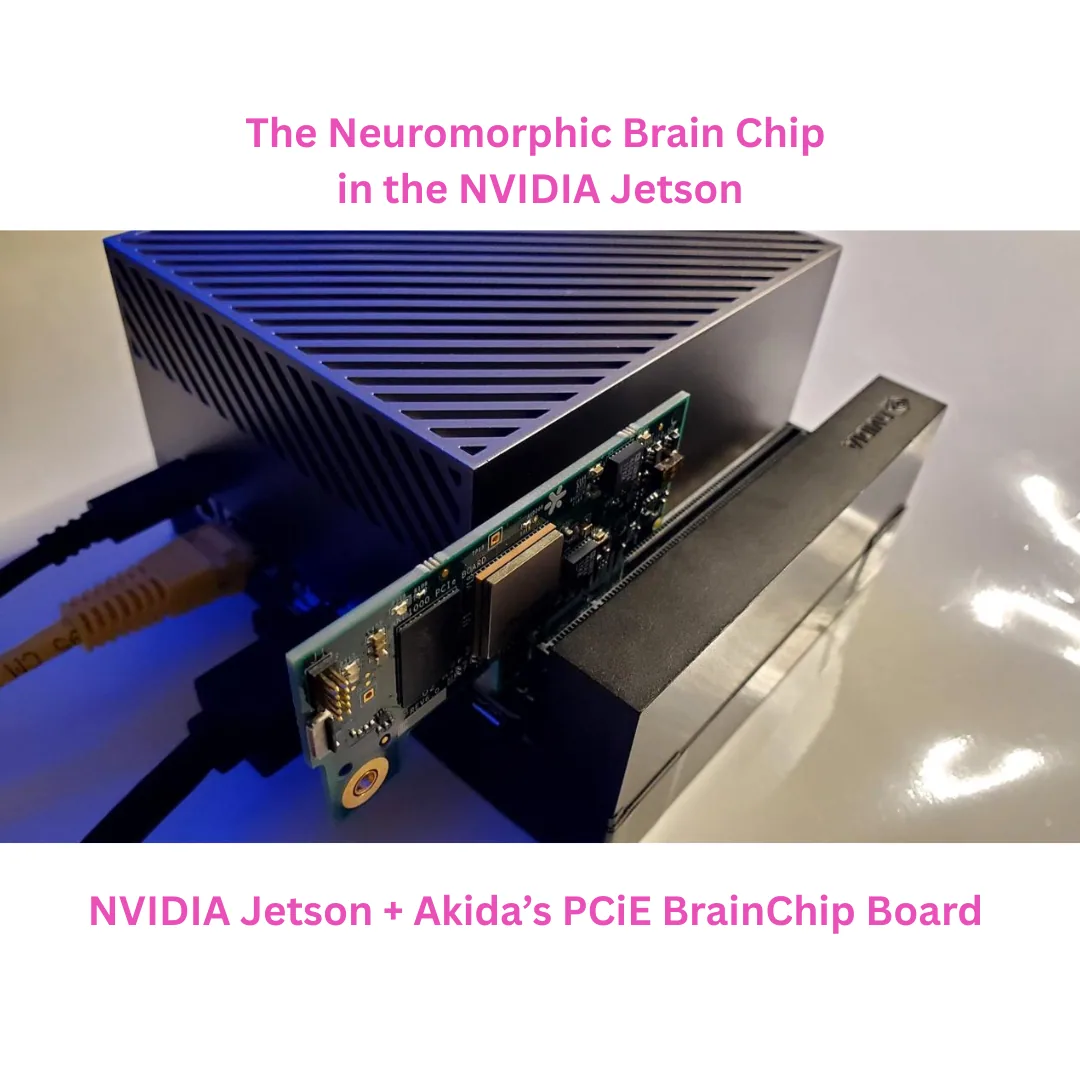
BrainChip Akida is a neuromorphic, event-driven processor built for always-on inference at very low power; NVIDIA Jetson is an embedded GPU platform built to run larger models with a mature software stack. For most edge systems the useful question is not which one wins but how to divide the work. In our San Antonio lab, a hybrid Jetson plus Akida deployment held the same accuracy at 9 W that the Jetson alone needed 120 W to reach.
This piece is the buyer's comparison. Our earlier post, our neuromorphic chip on NVIDIA Jetson, is the lab story behind that measurement.
Two different machines
Jetson is a family of embedded modules that put an NVIDIA GPU, CPU cores and accelerators on a small board. It runs the same CUDA, cuDNN and TensorRT stack as NVIDIA's data center hardware, packaged as JetPack. That means almost any model you can train in PyTorch can be exported, optimized and run on it, from object detectors to small language models. The cost of that generality is power: a GPU is a clocked machine that works on every frame whether or not anything in it has changed.
Akida is BrainChip's neuromorphic processor. It runs spiking and event-based neural networks, keeps weights next to the compute that uses them, and only does work when input events arrive. BrainChip's MetaTF tooling converts and quantizes suitable models, typically convolutional networks for vision, audio and sensor data, into a form Akida can run. It is designed to sit at the sensor, on a power budget measured in milliwatts to a few watts, and to support on-device learning for some tasks.
How they compare
- Compute model. Jetson: dense, clocked, frame by frame. Akida: sparse and event-driven, so quiet input costs little.
- Model range. Jetson runs nearly anything, including transformers and language models. Akida runs a narrower family of networks that convert well to event-based form.
- Tooling. Jetson has the mature NVIDIA stack and a large community. Akida's toolchain is younger, and porting a model is real engineering.
- Power profile. Jetson draws meaningful power continuously while it runs a model. Akida's draw scales with activity, which is what makes always-on sensing affordable.
- Best at. Jetson: detailed perception, fusion, larger models. Akida: detection, wake-up, keyword spotting, anomaly and change detection on sensor streams.
Why the hybrid wins
Most edge workloads are lopsided. A perimeter camera sees nothing interesting for most of the day. A pump's vibration sensor reports normal operation for months. A drone's acoustic sensor hears wind. Running a GPU continuously on that input is paying full price to confirm that nothing has happened.
The hybrid pattern splits the pipeline. Akida watches the stream continuously and cheaply, detecting the events that matter. When it fires, it wakes the Jetson, which runs the heavier model on the relevant window, classifies, fuses with other sensors and decides. Accuracy is set by the stage that does the detailed work, while average power is set mostly by the stage that runs all the time.
That is how the hybrid in our lab held matched accuracy at 9 W against 120 W for the Jetson alone. The exact ratio depends on the workload and especially on how often the front end has to wake the GPU, which is why we measure every deployment at the wall rather than quoting a universal figure.
How to decide for your platform
- Start from the power budget. What can the platform supply continuously, and on what battery or solar margin? That number often decides the architecture before anything else.
- Profile the input. How much of the time is the signal uneventful? The quieter it is, the more an event-driven front end saves.
- Find the always-on stage. Detection and wake-up tasks are usually good candidates for Akida. Detailed classification, fusion and anything transformer-based usually stays on the GPU.
- Prototype and measure. Convert the front-end model, check accuracy after conversion, and measure power, latency and accuracy on the real hardware under realistic duty cycles.
- Plan the software life cycle. Two toolchains means two update paths. Build the deployment and update process before fielding, especially for air-gapped platforms.
What a fair comparison measures
Datasheet figures for either platform describe ideal conditions. A comparison you can act on measures the whole system as it will be fielded. Measure power at the wall or the battery terminal, not from a software estimate, and record it over a realistic duty cycle that includes quiet periods, bursts of activity and wake-ups. Measure accuracy on held-out data after conversion and quantization, since a model that loses accuracy when converted to event-based form changes the trade. Record latency from sensor event to decision, including the time to wake the GPU from a low-power state. Note the enclosure and ambient temperature, because thermal throttling can change both power and latency on embedded boards. And record the software versions on both sides, so the measurement can be repeated after an update.
When Jetson alone is the right answer
If the platform has power to spare, the input is busy all the time, or the model needs architectures that do not convert well, a Jetson alone is simpler and perfectly sensible. Neuromorphic hardware is not a GPU replacement, and training stays on conventional accelerators. The hybrid earns its complexity when watts are scarce and the world is mostly quiet.
For the bigger picture, see our neuromorphic computing page, why neuromorphic computing matters, spiking neural networks at the edge, and edge and air-gapped AI.
Common questions
Is BrainChip Akida faster than NVIDIA Jetson?
They are built for different jobs, so speed depends on the workload. Akida responds quickly to sparse events at very low power; Jetson has far more raw throughput for large, dense models. Compare them on your model, your input and your power budget.
Can Akida run large language models?
No. Akida targets event-based and convolutional networks for vision, audio and sensor data. Language models and other transformer workloads belong on a GPU such as Jetson or on server hardware.
How much power does a Jetson plus Akida hybrid save?
It depends on the workload and how often the front end wakes the GPU. In our San Antonio lab, a hybrid held the same accuracy at 9 W that the Jetson alone needed 120 W for. Measure your own duty cycle before assuming a ratio.
What tools do I need to program Akida?
BrainChip's MetaTF tooling, which converts and quantizes suitable models for the Akida processor. Models are typically trained in a standard framework first and then converted.
Do I need neuromorphic hardware for edge AI?
Not always. If power is plentiful or the input is busy all the time, a GPU alone is simpler. Neuromorphic hardware pays off when the platform is power-limited and most input is uneventful.