
· By Roger Wong Won
BrainChip AKD1500: Add On-Device AI Without Replacing the Host
On November 13, 2026, BrainChip published a briefing on AKD1500, a dedicated neuromorphic co-processor meant to sit beside the host you already ship. Here is what the SPI and PCIe variants actually change, and how that fits the hybrid design we already measure in the lab.
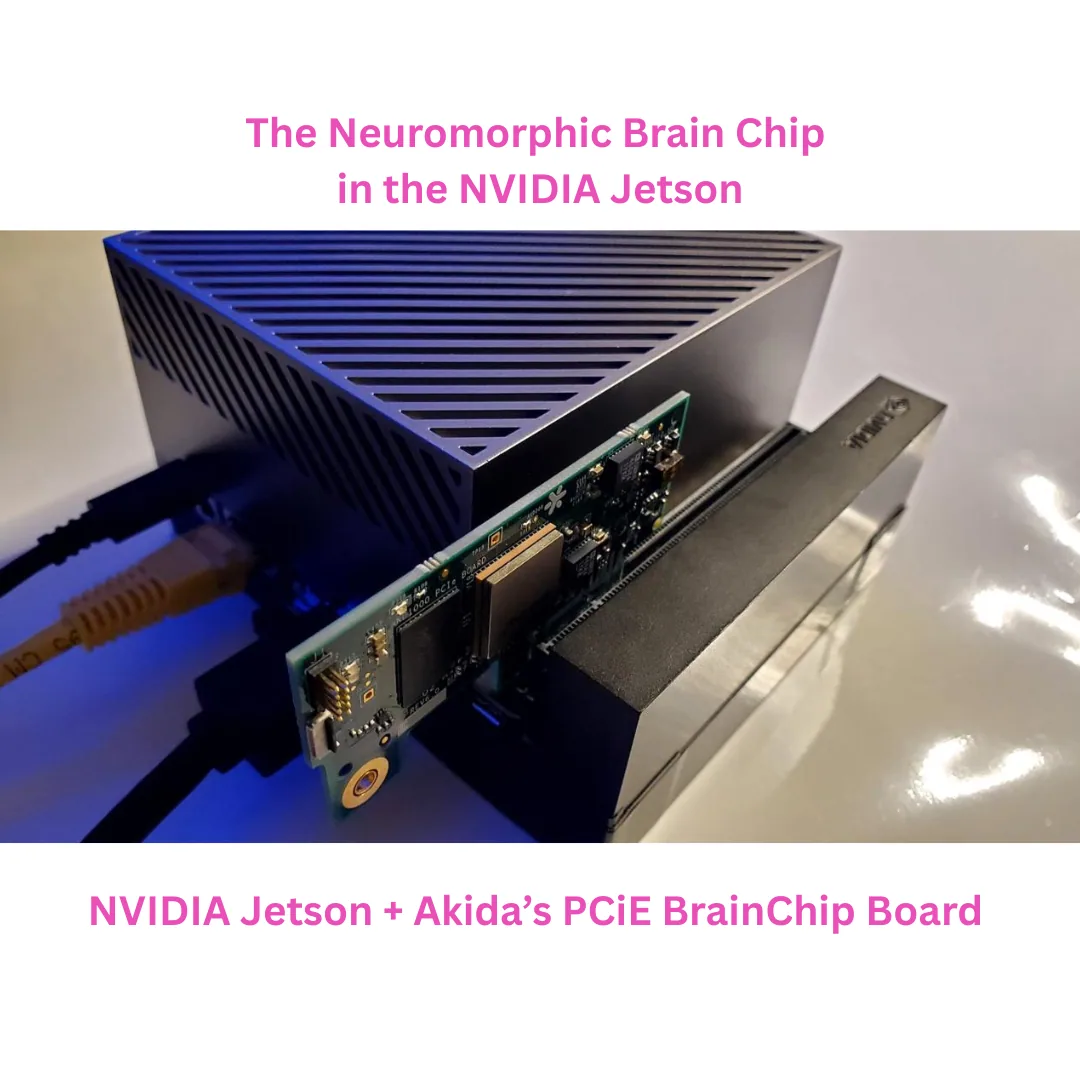
On November 13, 2026, BrainChip published a product briefing on AKD1500, a dedicated AI co-processor meant to sit beside the host you already ship rather than replace it. That is the same design pattern we use in the lab: keep the host that already runs the product, and add event-driven silicon where always-on inference has to stay cheap. In our San Antonio measurements, a hybrid NVIDIA Jetson plus BrainChip Akida deployment held the same accuracy at 9 W that the Jetson alone needed 120 W to reach. We are not claiming that figure was measured on AKD1500. It is the reason the briefing matters to us.
BrainChip first announced the AKD1500 SPI variant on October 22, 2026. Today's post is the fuller explanation of why a co-processor path exists at all, and how the SPI and PCIe versions split the work with a host.
The usual choice is a bad one
BrainChip's briefing puts the buyer's problem plainly. Adding AI to an edge device usually forces a choice. You can replace the processor you already ship with an AI-enabled MCU or SoC, which means a board respin, new firmware and a new qualification cycle. Or you can add an accelerator built for cameras and robots, then budget watts and a heatsink for it, which can mean redesigning the power supply, thermal design and form factor.
AKD1500 is offered as a third option: a dedicated AI co-processor next to the host architecture that already serves the product. The host keeps running the application. AKD1500 runs the neural network and returns the result. BrainChip's example is a smart speaker, where the MCU continues to handle audio capture, connectivity and the app, and passes microphone data to AKD1500 for keyword spotting.
SPI for the MCU you already have, PCIe when you need more
The family comes in two configurations, and BrainChip says both run the same models with the same tools.
The AKD1500 SPI pairs with the low-power microcontroller already inside battery-powered and embedded devices, using the SPI interface those MCUs typically already have. BrainChip points to wearables monitoring vital signs, smart home devices listening for keywords, and industrial IoT nodes detecting vibration anomalies at the sensor. The October announcement said the SPI chip is available now from the BrainChip Shop, DigiKey, or through BrainChip sales.
The AKD1500 PCIe pairs with an application processor in systems such as industrial PCs, edge servers and robots. BrainChip says it is built for performance and scale, can use host memory for larger models, and suits vision, multi-modal models and always-on anomaly detection. Development hardware is also offered as a PCIe development card and an M.2 card.
Steve Brightfield, BrainChip's chief product officer, said the family was built around how products are actually designed: the SPI device connects to the MCU a team already uses, and the PCIe device serves systems that need more performance, so customers can grow without starting over.
What is actually different
Two capabilities are the ones to test, not to take on faith.
The first is low-power inference from activation sparsity. AKD1500 uses BrainChip's event-based Akida architecture. The briefing says the chip skips inactive values inside a neural network instead of computing them, which cuts processing activity and power. That is the same event-driven idea behind neuromorphic silicon in general: work only when there is something to report. Whether a given model and duty cycle actually land inside your power budget is a measurement, not a datasheet promise. We wrote about how to think about that split in BrainChip Akida vs NVIDIA Jetson, and about the lab setup behind our 9 W figure in our neuromorphic chip on NVIDIA Jetson.
The second is on-device learning after the product ships. BrainChip describes on-chip learning for application personalization, with a concrete example from its AkidaTag reference platform: users can teach the device a new keyword through a companion app, with learning performed on-chip rather than through a cloud retraining pipeline. For platforms that cannot phone home, that is the sentence that matters. A learning step that requires a cloud round trip is not available in an air-gapped vehicle, a denied-link sensor or a clinic that will not let patient or mission data leave the perimeter.
BrainChip also says MetaTF is the development flow for compiling and optimizing models for AKD1500. We have used MetaTF in our own Akida work; we have not published a separate evaluation of the AKD1500 tool chain.
How we would put it on a bench
A co-processor announcement is a design option, not a result. If we were qualifying AKD1500 for a customer, we would keep the host fixed, add the co-processor on the interface the product already has, freeze the model and the duty cycle, and measure accuracy, latency and watts at the wall against the host alone. That is the same method behind the 9 W versus 120 W figure we do publish. Until those numbers exist for a named workload on AKD1500, we will not invent them.
The briefing is still useful now. It tells a platform team they may not need a board respin to try event-driven inference next to the processor they already trust. For physical AI, wearables, industrial sensing and machines that have to decide without a network, that is often the entire constraint.
If you want help scoping a host-plus-accelerator design, or a measured comparison against a Jetson-only baseline, request a briefing or email contact_us@theaicowboys.com. More of this work lives on our neuromorphic computing and edge AI pages.
Common questions
What is BrainChip AKD1500?
AKD1500 is BrainChip's dedicated AI co-processor in the Akida family. It is designed to sit beside an existing host rather than replace it. The SPI variant pairs with a microcontroller; the PCIe variant pairs with an application processor in larger edge systems. BrainChip says both run the same models with the same tools.
Did The AI Cowboys measure AKD1500 at 9 watts?
No. The published 9 W versus 120 W result is from a hybrid NVIDIA Jetson plus BrainChip Akida deployment in our San Antonio lab, at matched accuracy. We have not published a separate power measurement of AKD1500, and we do not apply that figure to this chip.
Why does on-device learning matter?
BrainChip describes on-chip learning for personalization after a product ships, including an AkidaTag demo in which a new keyword is taught on the device rather than through a cloud retraining pipeline. For air-gapped or denied-link systems, a learning step that requires the cloud is not available.