
· By Roger Wong Won
Vote for InvisibleSignal: People's Choice Voting Is Open in the TOPx HHS Tech Sprint
People's Choice voting is open in the TOPx HHS Tech Sprint for AI and Invisible Illness, and InvisibleSignal, our Lyme Innovation entry, is on the ballot. Here is why we built it, what it does, and how to vote with a free account and one thumbs-up.
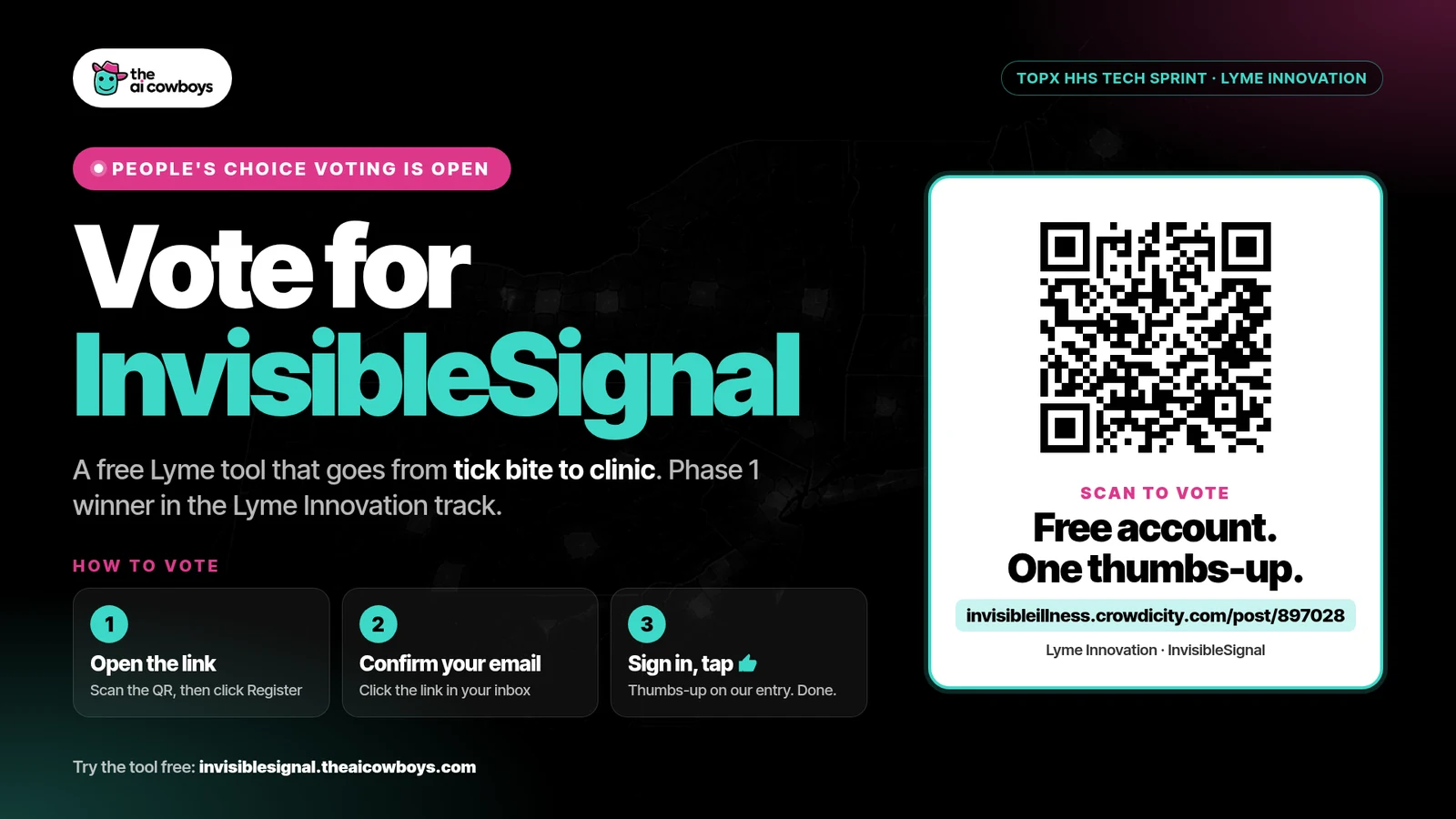
Vote for InvisibleSignal: invisibleillness.crowdicity.com/post/897028
People's Choice voting is open in the TOPx HHS Tech Sprint for AI and Invisible Illness, and InvisibleSignal, our entry in the Lyme Innovation track, is on the ballot. Voting takes a free account and one thumbs-up. Here is why we built it, what it does, and exactly how to vote.
Why it matters
Lyme disease is the most common vector-borne illness in the United States, and one of the hardest to see. CDC estimates that about 476,000 Americans are diagnosed and treated for Lyme each year, yet only about 89,000 cases were reported through national surveillance in 2023. An estimated 31 million Americans are bitten by ticks every year. Most of that gap is never counted anywhere.
For patients, the invisibility is personal. Two-tier testing has under 50% sensitivity in early disease, and up to 30% of patients never develop the classic bull's-eye rash. In patient surveys, 51% report it took more than three years to be diagnosed. People cycle through other labels while nobody asks about the tick.
It is personal for us too. Several people on our team have watched family members go years without a Lyme diagnosis. That experience shaped every product decision we made.
What InvisibleSignal does
InvisibleSignal (SENTINEL: Lyme intelligence for the bite-to-clinic journey) was built by The AI Cowboys and led by our CTO, Jacqueline Loyland. It is live today at invisiblesignal.theaicowboys.com, free, and the public tools need no account. It walks a person from "I found a tick" to "my clinician has what they need":
- County-level CDC surveillance with explicit completeness. 152,018 reported cases, reconciled exactly to published state totals. Where CDC could not code a county, the map says so instead of showing a zero. Absence of measurement is never presented as absence of risk.
- A transparent risk index, validated out-of-sample. Four published weights and no learned parameters. Every risk brief includes a section titled "What this brief does not establish."
- An exposure-first screener. It asks about tick exposure, season and geography before symptoms, reports symptom overlap as overlap and never as a probability of disease, and routes red-flag symptoms to emergency care before any model runs.
- Cited evidence retrieval. Answers come from a corpus of 33 findings from 7 published sources. The AI must cite a known source or refuse.
- A clinician-ready FHIR export. Your confirmed record exports as an HL7 FHIR R4 document, coded with LOINC, SNOMED and ICD-10, that a clinician's EHR can ingest.
- Field Mode that works offline. Log a bite with a GPS pin and a photo at the trailhead, with CDC risk data for all 3,231 U.S. counties stored on the device.
It does not diagnose, and it never pretends to. It helps you walk into a ten-minute appointment with an organized, cited history instead of a story that starts from zero.
InvisibleSignal was a Phase 1 winner in the Lyme Innovation track. In Phase 2 we shipped it as a working product, not a prototype.
How to vote
- Open the voting page: invisibleillness.crowdicity.com/post/897028. Click Register at the top right and create a free account with a display name, email and password, then accept the Terms of Use.
- Verify your email. Crowdicity sends a verification link. Click it. If it has not arrived in a few minutes, check spam or promotions.
- Sign in and vote. Go back to the InvisibleSignal entry and click the thumbs-up. The vote count goes up by one. There is no thumbs-down.
Anyone can vote. You do not have to be part of the sprint. Please vote once from your own account and do not create extra accounts. Real votes from real people are the whole point. While you are there, look around at the other entries. There is a lot of good work in this sprint.
When to vote
Voting opened October 23. The organizers said the public voting period runs about 30 days, and the official rules list it as October and November 2026. No exact close date has been published. Phase 2 winners are announced November 3 at the Edge of Medicine event, so we are asking everyone to vote by Monday, November 2. Today is even better.
Why your vote counts
Under the official rules, public voting, leaderboard activity and participant engagement may inform the Federal Judging Panel's decisions, including the People's Choice Awards. Your thumbs-up tells the judges that a free, honest, bite-to-clinic Lyme tool is something people want.
If you have ever pulled a tick off a kid, a dog or yourself, this one is for you. Please vote, then send it to one person who would care.
Vote for InvisibleSignal: invisibleillness.crowdicity.com/post/897028
Common questions
Do I need an account to vote?
Yes. Voting happens on the challenge site, invisibleillness.crowdicity.com, and you need a free Crowdicity account with a verified email address. Register, click the verification link in your email, sign in, then tap the thumbs-up on the InvisibleSignal entry.
Who can vote?
The public. You do not have to be part of the sprint to vote. Voting is open across all three tracks of the TOPx HHS Tech Sprint.
When does voting close?
No exact close date has been published. Voting opened October 23, and organizers said the public voting period would run about 30 days. The official rules list the People's Choice voting period as October and November 2026. Phase 2 winners are announced November 3, so we are asking everyone to vote by Monday, November 2.