How Large Language Models (LLMs) Will Transform AI Engineering in 2026
How Large Language Models (LLMs) Will Transform AI Engineering in 2026
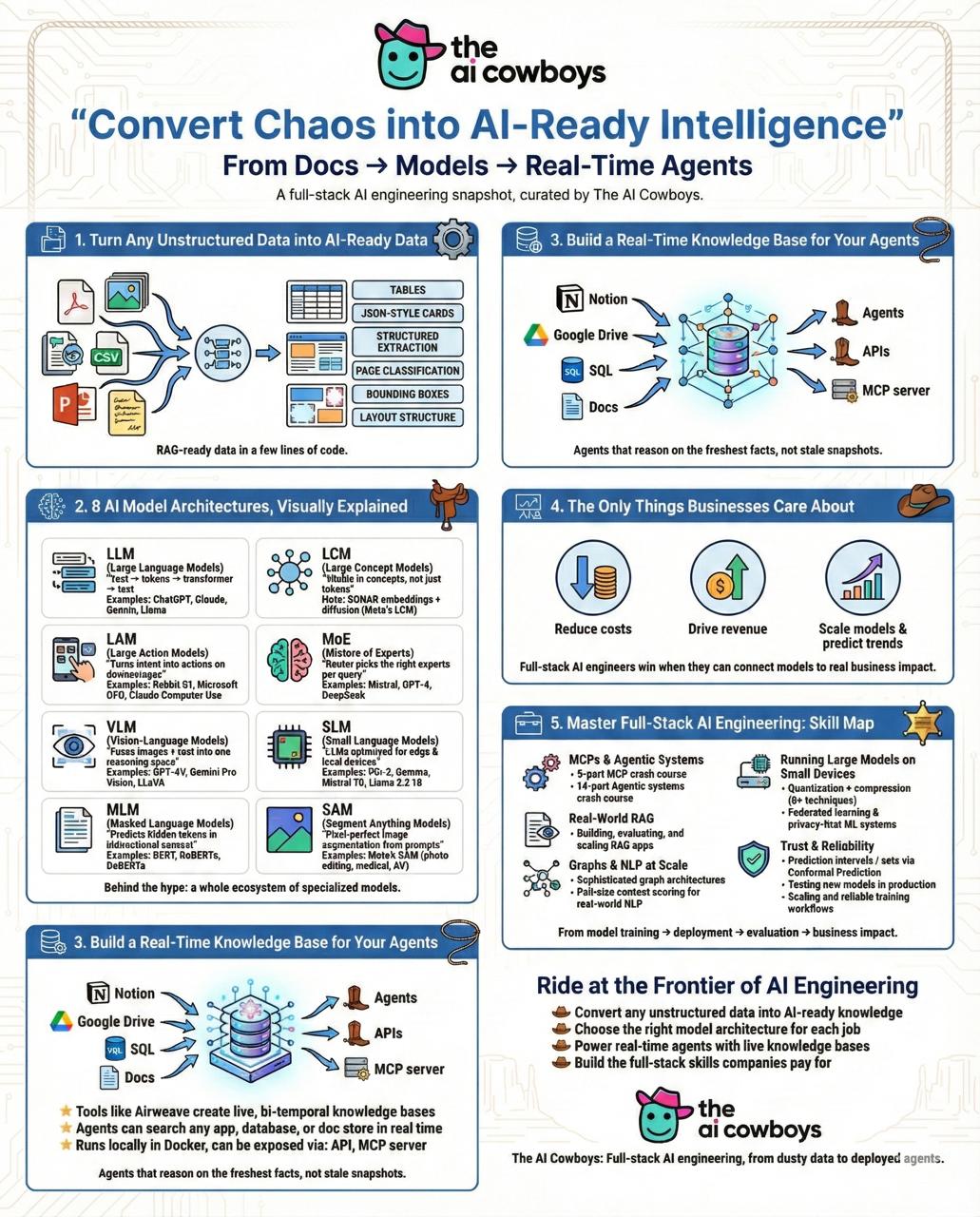


Large Language Models—commonly known as LLMs—have moved from experimental tools to foundational infrastructure for modern AI-driven organizations. They now power chatbots, copilots, document intelligence systems, cybersecurity agents, enterprise automation, and the next generation of operational workflows. But with this explosion of innovation comes a critical challenge:
How do you convert raw, unstructured, messy data into clean, AI-ready intelligence that LLMs can reason over?
This is where full-stack AI engineering enters the picture, and where companies like The AI Cowboys are redefining what’s possible with production-grade AI systems.
What Is an LLM?
A Large Language Model is an advanced AI system trained on billions of text tokens to understand, generate, and interpret language at a near-human level. LLMs can:
- Analyze documents
- Summarize complex information
- Extract structured data
- Assist with reasoning and decision-making
- Power real-time agents
This family includes models such as:
- OpenAI GPT-4o, GPT-5
- Anthropic Claude 3.5
- Google Gemini 1.5 & 2.0
- Meta LLaMA 3
Authoritative references:
https://developers.google.com/machine-learning/large-language-models
https://platform.openai.com/docs/guides
Why LLMs Alone Aren’t Enough for Most Companies
Installing an API key into your app won’t generate business impact on its own.
LLMs still require:
- Clean, structured, RAG-ready data
- A real-time knowledge base
- A full-stack architecture to unify agents and workflows
- Reliable API orchestration
- Guardrails for trust, safety, and compliance
The companies achieving real ROI are the ones building end-to-end AI systems, not isolated chatbots.
Turning Raw Data Into AI-Ready Intelligence
Most organizations have massive amounts of unstructured data scattered across:
- PDFs
- Email inboxes
- Contracts
- Shared drives
- Government documents
- Legacy databases
To make this information usable, AI engineering applies:
- Document parsing
- Structured extraction
- Page classification
- Table recognition
- Bounding boxes + layout mapping
- Semantic labeling
Research reference:
https://arxiv.org/abs/2308.13418
(Document Intelligence & Layout Models)
This converts chaos into LLM-ready knowledge.
Building Real-Time Knowledge Bases for AI Agents
Traditional knowledge bases are static, outdated, and siloed.
Modern AI systems require live, dynamic, event-driven knowledge layers that connect tools like:
- Notion
- Google Drive
- SQL databases
- Internal document repositories
This enables LLM-powered agents to think using the freshest information, not stale snapshots.
Model Context Protocol (MCP) resources:
The Expanding Universe of LLM Architectures
LLMs now include a wide variety of specialized model families:
- LLM: General reasoning models
- LCM: Latent concept models
- MoE: Mixture-of-experts
- VLM: Vision-language models
- SLM: Small language models for edge devices
- SAM: Segment Anything Models for visual segmentation
Reference:
https://arxiv.org/abs/2207.04662 (MoE research)
https://segment-anything.com/ (SAM)
This multi-model ecosystem allows companies to tailor AI stacks for cost, accuracy, and performance.
The Business Impact of LLMs
Executives consistently focus on three outcomes:
1. Reducing Costs
Automation + intelligent systems lower operational overhead and eliminate repetitive workflows.
2. Driving Revenue
AI copilots unlock new services, accelerate delivery, and increase customer engagement.
3. Scaling With Confidence
LLMs grow with your organization—more data means more intelligence and more value.
Full-Stack AI Engineering: The Future of Modern AI
The next evolution of enterprise AI goes far beyond plugging into an API.
Companies now require:
- Real-time RAG pipelines
- API and system orchestration
- AI-driven agents
- Trust and reliability frameworks
- Long-context processing
- Structured knowledge layers
- Multi-modal intelligence
This is the AI frontier, and it’s already reshaping competitive advantage across every industry.
The AI Cowboys: Leading the Next Era of Applied AI
The AI Cowboys specialize in turning:
Documents → Intelligence → Models → Real-Time Agents
If your organization wants to build AI that truly impacts operations, revenue, and scale, this is the engineering approach that delivers.
Ready to modernize your workflows with LLMs, RAG pipelines, and real-time AI agents?
👉 www.theaicowboys.com
